
January 27, 2026
Cloud adoption solved infrastructure dependency—but introduced a new challenge: operational complexity. As businesses scale across AWS, Azure, and GCP, the real...
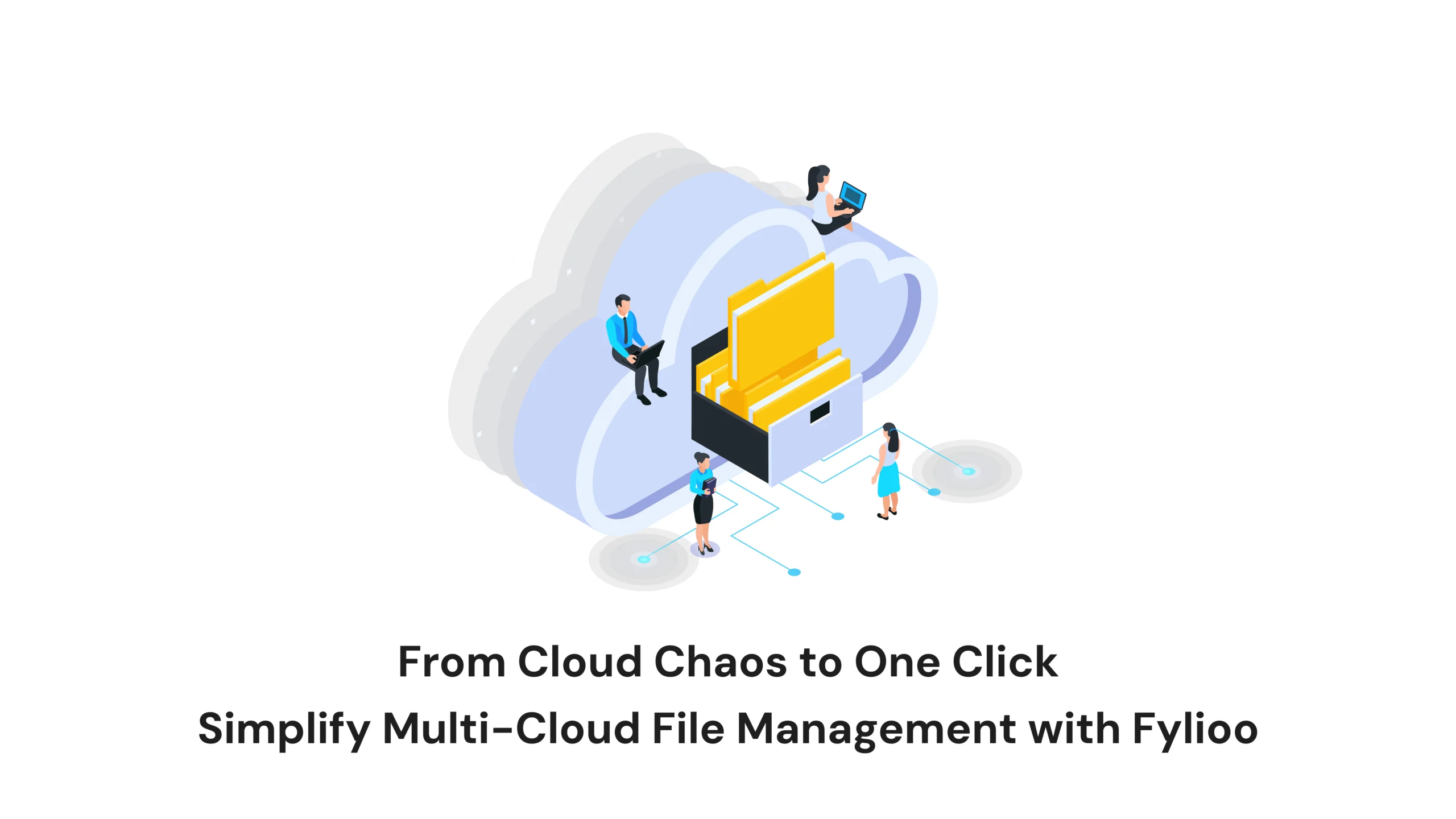
Modern businesses don’t rely on just one cloud anymore. Marketing assets may sit in Google Cloud, backups in AWS, and analytics files in Azure. While this “best-of-breed” approach offers flexibility, it quietly creates everyday frustration.
Modern businesses don’t rely on just one cloud anymore. Marketing assets may sit in Google Cloud, backups in AWS, and analytics files in Azure. While this “best-of-breed” approach offers flexibility, it quietly creates everyday frustration.
Teams waste time switching between cloud dashboards, files get duplicated “just in case,” and no one is ever fully sure who accessed what. Studies on multi-cloud adoption consistently highlight the same issues: operational complexity, governance gaps, and cost leakage when visibility is poor.
What starts as a smart infrastructure decision slowly turns into daily cloud chaos.
Fylioo solves this problem with one clear idea: manage all your cloud files from one place.
Instead of logging into multiple cloud consoles, Fylioo connects to your existing cloud storage and shows everything in a single, easy-to-use interface. Teams can browse, search, move, and share files across clouds without changing tools or learning complex workflows.
You can explore how this works directly on the
👉 Fylioo homepage
Think of it as a universal remote for your cloud storage—one dashboard instead of three.
Find any file in seconds
One of the biggest hidden productivity killers is file search time. When files live across clouds, people stop searching and start asking colleagues—or worse, recreating files.
Fylioo indexes file metadata across providers, allowing users to search once and see results everywhere. This dramatically reduces interruptions and speeds up everyday work.
Learn more about how centralized access works in Fylioo’s
👉 multi-cloud storage management overview
Reduce storage waste and unexpected cloud costs
Without a unified view, teams duplicate files across clouds, keep old backups forever, and lose track of cold data. Industry research shows this is one of the biggest reasons multi-cloud bills grow faster than expected.
Fylioo helps teams see where data lives, identify redundancy, and manage transfers intentionally—so storage costs stay under control instead of quietly growing month after month.
Share files securely without losing control
Emailing attachments or downloading files locally creates security risks and compliance gaps. In multi-cloud environments, these risks multiply.
Fylioo enables secure sharing through controlled links, permission settings, and centralized access logs. That means teams collaborate faster while administrators retain visibility and audit readiness.
This aligns closely with best practices highlighted in multi-cloud security and governance research.
Move data between clouds without fragile scripts
Cloud-to-cloud migration is often handled with custom scripts that break, fail silently, or cause downtime. That makes even simple migrations risky.
Fylioo supports structured cloud-to-cloud transfers and syncs, reducing dependency on manual scripting and lowering operational risk during migrations.
You can see how Fylioo positions itself in this space through its
👉 product capabilities and resources
Priya is a product manager at an ecommerce company.
Her marketing team needs product images stored in Azure, while the website runs on AWS. Earlier, this meant downloading files locally, re-uploading them, and creating multiple versions.
With Fylioo, Priya opens one dashboard, searches the product ID, finds the image, and shares a secure link—without touching cloud consoles or local storage.
What once took 20–30 minutes (or a DevOps ticket) now takes under five minutes. Multiply that by dozens of small requests every week, and the productivity gain becomes obvious.
Academic literature on multi-cloud management consistently shows that complexity—not infrastructure capability—is the biggest barrier to success. Organizations struggle most with visibility, governance, and operational overhead.
Industry analysis echoes this: multi-cloud delivers resilience and flexibility, but only when supported by tools that centralize control and reduce cognitive load on teams.
Fylioo fits directly into this gap by focusing on operational simplicity rather than replacing cloud providers.
It’s important to be realistic. Fylioo doesn’t replace cloud-native security controls, identity providers, or advanced provider-specific services. Those still matter.
What it does replace is the daily friction:
Used alongside proper governance and security practices, it becomes a strong operational layer for multi-cloud teams.
Before adopting any multi-cloud tool, ask:
If the answer to most of these is “yes,” a centralized tool like Fylioo is worth evaluating.
Start with a small workflow, measure time saved, and expand from there.
Multi-cloud doesn’t have to mean multi-level confusion.
By bringing all cloud files into a single, searchable, and secure interface, Fylioo turns everyday cloud chaos into a one-click experience. The result is faster work, better cost control, and fewer operational headaches—without forcing teams to change how they already use the cloud.
For companies already living in more than one cloud, that simplicity isn’t a luxury anymore. It’s a necessity.
Fylioo solves the everyday chaos caused by storing files across multiple cloud providers like AWS, Google Cloud, and Azure. Instead of switching between different dashboards, teams can browse, search, move, and share all their cloud files from one centralized interface—saving time, reducing errors, and improving visibility.
No. Fylioo does not replace cloud providers. It works on top of them as a management and access layer. Your data stays in your existing cloud storage; Fylioo simply makes it easier to manage, search, and move files across providers without changing your infrastructure.
Fylioo is especially useful for marketing teams, product teams, DevOps, IT operations, and fast-growing companies that use more than one cloud provider. Any team that frequently searches for files, shares assets externally, or migrates data between clouds will see immediate productivity and cost-control benefits.
Cloud adoption solved infrastructure dependency—but introduced a new challenge: operational complexity. As businesses scale across AWS, Azure, and GCP, the real...
A few years ago, cloud storage was considered a background system. It quietly stored files, ran backups, and supported applications without...
Most teams move to the cloud for the same reason — flexibility. You can scale when needed. You can store unlimited...
WhatsApp us